





December 23, 2025
The Great Financial Deception: Why Cost-Cutting AI is the Ultimate Tax on Growth
Let’s be brutally honest as the year closes: The wheel is flat, and AI just ran over it.
If your financial institution spent the last year using AI purely to make old, broken processes 15% faster, or if you’re treating generative AI like a slightly fancier content intern, you’re missing the point. You didn’t invest in the future – you just bought a faster route for an outdated strategy.
The lie that dominates board reports is the focus on efficiency. This focus makes you strategically irrelevant. AI isn’t here to make your current systems marginally cheaper; it’s here to build new, compliant revenue streams that redefine your market position. This is the difference between marginal optimisation and total re-architecture. This is why the adoption statistics are misleading: 73% of firms using AI for creative is fine. But only 48% using it for strategy means the market is still stuck in the tactics.
The Realisation: Where Marketing Must Re-Engineer (Not Just Re-Tool)
The market reality for 2026 is that financial winners won’t be defined by how much they automated. They’ll be defined by how much new, auditable value they created. We need to move the conversation from tactical savings to strategic creation.
1. From Personalisation to Hyper-Suitability
Your competitor’s AI might be better at suggesting a product. Our AI needs to be better at ensuring that product is perfectly suited to the client’s risk profile and financial objectives, with compliance embedded at the moment of sale.
The Lie: That you can personalise at scale with old CRM rules.
The New Perspective : AI enables precise financial alignment. It examines a client’s entire wealth or risk footprint and proactively delivers the right financial instrument, at the right time, with compliant disclosure built-in. This is the difference between sending a generic ad and engineering a validated transaction.
2. The Creative Leap: Risk as Innovation Fuel
The Creative Paradox – where AI is a co-creator, not a copywriter – takes a specific shape in BFSI. It’s not about designing 7 million unique labels; it’s about 7 million unique, real-time risk assessments that power customer engagement.
The Lie: That you have to choose between speed (innovation) and safety (compliance).
The New Perspective : Applying machine learning to GRC (Governance, Risk, and Compliance) is not about reporting faster. It’s about creating Embedded Assurance—a self-correcting system that verifies every stage of a financial process before execution. This turns compliance from a handbrake on innovation into a competitive advantage. The value isn’t just time saved; it’s the predictive insight that surfaces a profitable, safe opportunity (like an uncommon peril combination) that a human analyst couldn’t find alone. The technology doesn’t just manage risk; it surfaces growth.
3. The New Asset is Verifiable Integrity
The Risk, Ethics & the CMO’s Headache is magnified in our sector. You’re not just deciding how comfortable you are with AI representing your brand’s soul; you’re deciding how comfortable you are with AI managing millions in client assets.
The Lie: That marketing budget should be focused purely on content volume.
The New Perspective : Marketing’s most critical investment is in System Clarity and Decision Traceability. The most valuable asset you own is not your logo; it is the verifiable, auditable trail of how your AI model managed a client’s portfolio risk. You must market your controls to build trust.
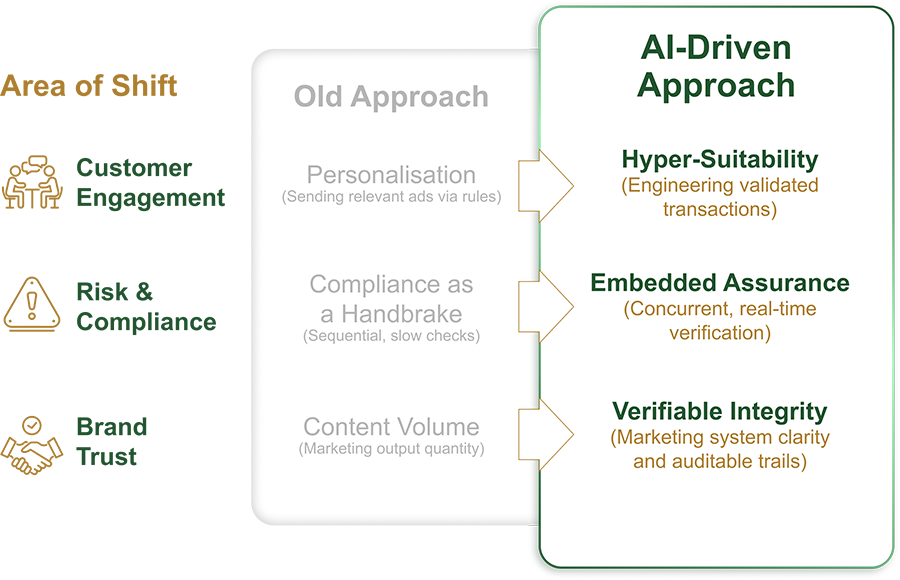
What CMOs Must Re-Architect for 2026
To achieve this pivot the shift from automating existing inefficiency to engineering new revenue streams – the CMO agenda requires a serious structural overhaul:
- Stop treating AI like an intern. Use it for Ideation and Prototyping of new revenue products, not just to churn out emails. Let it surprise you by combining complex regulatory data with market signals to suggest novel offerings.
- Demand Transactional Metrics: Build a measurement playbook for AI that aligns with the CFO. Define KPIs not in clicks or impressions, but in RM productivity uplift, reduced time-to-transaction, and the net revenue gain from suitable product recommendations. Without measurement, AI is just a black box (and not the cool sci-fi kind).
- Transform Talent Composition: Upskill, or hire. The new team members don’t just write copy; they understand credit underwriting models, portfolio construction rules, and regulatory filing standards. This means actively recruiting and training for roles like AI-Fluent Strategist and Data-Driven Storyteller. Marketing is now a function of data literacy and technical empathy. You must bring in roles that bridge the gap between financial risk and market voice, because the best creative brief is now a risk model specification.
The Year-End Conclusion
If I were to sum up the brutal reality for every financial CMO heading into 2026, it would be this:
Either learn to ride the AI wave as a growth architect, or figure out another beach to retire on. Because the cost of AI is only worth paying if it transforms your business from a defensive fortress into a compliant, offensive revenue-generating machine.
The market rewards the future you build.
Author:

Tarunya Suresh
Chief Marketing Officer – Wealth & GRC

Related Articles

What Makes a Redress Decision Explainable to Regulators?

How to Choose the Right Wealth Management Software for Your Firm in 2026

What Does the FCA Expect From Firms During Large-Scale Redress?