





December 16, 2025
How to Choose the Right Insurance Underwriting Software for Your Team: The 2026 Insurtech Guide
Table of Contents
Talk to an Expert
See how the IntellectAI’s Xponent underwriting platform gives your team the efficiency tools to drive real, profitable results
December 16, 2025
How to Choose the Right Insurance Underwriting Software for Your Team: The 2026 Insurtech Guide
Why Your “Good Enough” Underwriting Process is Costing You Money
Most underwriting teams are still stuck working out of inboxes, PDFs, spreadsheets, and outdated systems that never quite talk to each other. It slows everything down, leads to data errors, and leaves agents and brokers frustrated when they can’t get a clear answer on a quote
It’s not just an operational headache. It’s a competitive disadvantage.
The carriers and MGAs winning business today are the ones shifting to modern insurance underwriting software built to support Straight-Through Processing, speed up quote turnaround, and give underwriters the time and tools to focus on complex risks, not paperwork.
If you’re evaluating new commercial insurance underwriting software, you’re in the right place. This guide gives you a clear framework for choosing one that drives real ROI and fits the way your team works.
Before You Implement Solutions: The 3 Steps to Define Your Underwriting “North Star”
You can’t choose the right platform if you’re not aligned on the problem you’re solving.
1. Identify Your Key Bottlenecks
Start by getting honest about what slows you down. For most teams, it could be one or more of the following:
- Submission intake is chaotic and manual
- Data validation takes too long
- Underwriters can’t get the insights they need without hunting across multiple systems
- Too much work gets stuck waiting for someone’s review
2. Set Clear, Measurable Goals
What is your primary objective? Some examples may be:
- Increase straight-through processing rate by 40%
- Reduce quote turnaround time to 24 hours
- Improve underwriter productivity by 30%
These goals become your underwriting software selection criteria.
3. Involve All Stakeholders Early
A successful underwriting transformation strategy needs voices from:
- Underwriting: The people using it every day
- IT: Integration, architecture, security
- Operations: Process and workflow governance
Their input will make or break adoption.
The 7 Must-Have Features of Modern Underwriting Software
To stay competitive in 2026 and beyond, these features are non-negotiable. Any platform missing even one will become tomorrow’s technical debt.
Intelligent Workflow Automation and Low-Code Rules Engine:
Look for underwriting workflow automation that moves beyond simple rules. Your platform should automate:
- Task routing
- Data validation
- Follow-ups
- Agent/broker communications
A low-code/no-code underwriting rules engine is a must. Underwriting managers, not just IT professionals, should be able to update rules as appetite, products, or loss trends shift.
AI Analytics for Risk Assessment
This is where modern platforms separate themselves. The right AI underwriting software will:
- Score risk in real time
- Triage submissions so low-complexity risks can auto-approve, and complex risks get flagged for human review
- Use natural language processing to extract and normalize data from emails, reports, ACORD forms, inspections, and third-party sources
Underwriting risk assessment tools reduce manual touchpoints and give underwriters better information earlier in the process.
Robust Integration & API-First Architecture
If the tool can’t integrate easily, it won’t last.
Your platform must have strong, open APIs and pre-built connectors for your:
- Policy administration system
- CRM
- Rating systems
- Third-party data partners
Seamless underwriting software integration ensures you’re not creating new data silos on top of old ones.
Automated Submission Intake & Data Ingestion
A modern digital underwriting workbench platform should automatically:
- Read ACORDs, PDFs, emails, and scanned documents
- Extract structured data
- Map fields correctly
- Flag missing or inconsistent information
This removes hours of manual rekeying and reduces errors.
A Unified Underwriting Workbench
Underwriters don’t want ten open tabs. A good underwriting workbench platform keeps everything on one screen:
- Quote details
- Documents
- Risk scores
- Guidelines
- Communication tools
- Task lists
A unified view cuts friction and helps underwriters work with clarity.
Comprehensive Analytics & Portfolio Reporting
Real-time insights matter. Your platform should deliver dashboards on:
- Submission volume
- Capacity and workload
- Quote-to-bind ratios
- Loss trends
- Portfolio risk distribution
This helps leaders make decisions faster and steer underwriting strategy with confidence.
Security, Compliance & Audit Trails
Nothing matters if the system isn’t secure. Your solution must include:
- Full audit trails
- Role-based permissions
- State and regulatory compliance controls
- SOC2 / ISO certifications
- Data residency options
This protects your business and satisfies regulators.
A 5-Step Framework for Choosing Your Underwriting Software
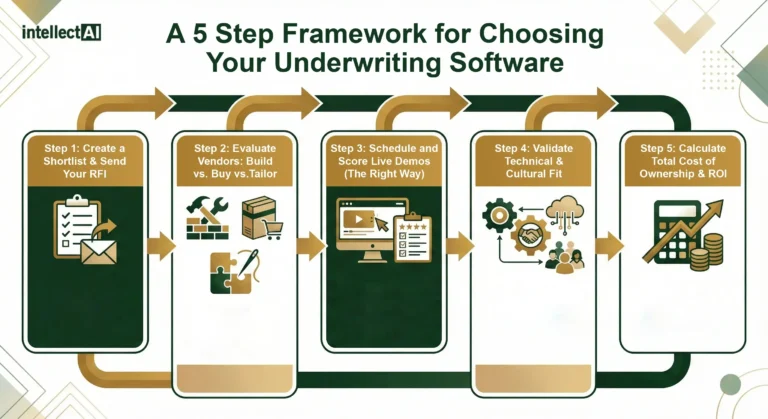
Once you’re clear on goals and features, use this process to narrow your options.
Step 1: Create a Shortlist & Send Your RFI
Focus on vendors that already support your lines of business, such as P&C underwriting software for commercial or specialty lines.
Step 2: Evaluate Vendors: Build vs. Buy vs. Tailor
A quick breakdown:
- Build: High control, but slow, expensive, and difficult to maintain.
- Buy: Faster but often rigid, especially when your appetite or workflow changes.
- Tailor: A middle ground that gives you enterprise stability with the flexibility to adapt (this is where modern platforms excel).
Step 3: Schedule and Score Live Demos (The Right Way)
Don’t settle for a canned walkthrough. Send the vendor 2-3 real use cases and score the demo using criteria based on the seven features above.
Step 4: Validate Technical & Cultural Fit
You’re evaluating technology and a potential long-term partnership. Chat with existing customers to ask the following questions:
- How smooth was the implementation?
- How responsive is support?
- How often do they ship product enhancements?
- How customizable is the platform after go-live?
Step 5: Calculate Total Cost of Ownership & ROI
Look beyond the license fee. Also include:
- Integration
- Implementation
- Training
- Ongoing maintenance
Then compare that cost to the potential return from:
- Faster quotes
- Higher STP
- Reduced manual work
- Fewer errors
- Better experience
- More new business
This is where the true value comes in.
Don’t Eliminate Your Underwriters, Empower Them
The goal isn’t to remove the human element from underwriting. It’s to provide your best people the tools to do their best work.
A strong insurance underwriting software foundation gives teams the speed, visibility, and consistency they need, while a flexible digital underwriting workbench platform keeps workflows aligned with how underwriters actually work.
If you’re evaluating new insurance underwriting software solutions, it’s worth seeing how the right digital underwriting workbench platform can help your team quote faster, make better decisions, and handle more business with less friction.
Discover how IntellectAI’s Xponent brings AI-driven precision to underwriting software for insurance carriers and MGAs, purpose-built for commercial and specialty lines.
Schedule a strategy call today!

Cara Carlone



Cara Carlone

Related Articles

What Makes a Redress Decision Explainable to Regulators?

How to Choose the Right Wealth Management Software for Your Firm in 2026

What Does the FCA Expect From Firms During Large-Scale Redress?