





June 09, 2026
The Insurance Talent Gap: Bridging the Underwriting Vacuum
It may come as no surprise that the insurance industry is currently facing a looming talent gap. This “Silver Tsunami” is a quiet but devastating tide. As of 2026, the industry is staring down a massive deficit, needing to fill 400,000 positions to maintain stability.
Forward thinking organizations are beginning to recognize that this insurance talent gap is not merely a labor shortage. It is actually a legacy architecture problem, specifically as it relates to underwriting.
Underwriting is considered the intellectual engine of insurance, and for years, organizations have relied on the intuitive genius of veteran underwriters. As these experts retire, the industry faces a critical erosion of its foundational intelligence, where decades of institutional wisdom are disappearing faster than they can be replaced.
The Quantified Crisis: Experience Debt and the Burnout Loop
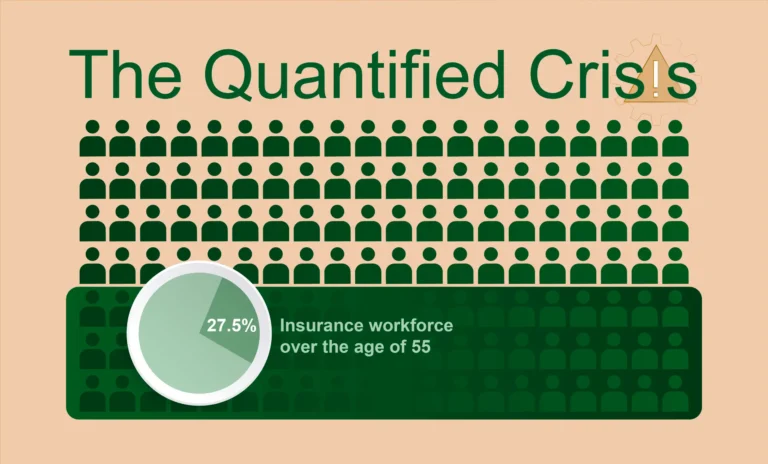
The numbers tell a sobering story. Currently, 27.5% of the insurance workforce is over the age of 55. This demographic shift has created a dangerous experience debt.
-
The Mental Model Risk: Losing a 30-year senior underwriter isn’t just a headcount issue. It’s the loss of a sophisticated mental model of risk; the kind of nuanced decision-making that can’t be found in a manual.
-
The Burnout Loop: As veterans exit, the remaining staff face desk pressure, being forced to do more with less. This leads to a feedback loop of attrition where high-potential talent leaves due to burnout, further widening the gap.
The Recruitment Barrier
To the next generation of talent, the insurance industry often has an image problem. It’s perceived as stale, manual, and paper-heavy. In a world of slick UX and instant data, Gen Z isn’t interested in legacy systems. To win them over, insurance companies must stop looking like administrative hubs and start looking like tech companies. The battle for talent will be won by those who provide modern, intuitive tools that allow new hires to focus on strategy rather than data entry
Bridging the Gap: AI as the Ultimate Force Multiplier

Hiring faster is not the solution. Rather, organizations should focus on moving from manual to cognitive workflows. This is where AI acts as a co-pilot, preserving institutional knowledge before it walks out the door.
- The Power of Knowledge Capture: The key is to move beyond simple data entry and toward digitizing institutional wisdom. For example, a modern underwriting workbench should offer a specialized Underwriting Thought Process capability. Instead of recording a “yes” or “no” on a submission, it captures the decision rationale and the why behind every risk assessment.
- By using a system like Xponent Underwriting, this brain trust of retiring veterans is embedded directly into the platform. This allows junior underwriters to do more than just process a file. They can review, learn from, and replicate the logic of senior experts in real-time, effectively accelerating their professional development through technology.
A Strategic Roadmap for Leadership
For Chief Operating Officers and Chief Underwriting Officers, the path forward requires a shift in priorities:
-
Audit the Friction: Identify the administrative black holes where your team spends 40% of their time.
-
Deploy Decision Support: Use AI to handle the science (data gathering, basic triaging) so humans can handle the art (complex negotiation and relationship building).
-
Market Your Tech Stack: Use your digital transformation as a recruiting tool. A tech-forward environment is a magnet for top-tier graduates who want to work with cutting edge technology.
Conclusion: Future-Proofing the Organization
The talent gap is not a temporary dip, it is a permanent shift in the labor landscape. To survive, carriers must stop trying to fill seats with the same old methods and start upgrading the desk itself. By capturing the elite logic of senior underwriters today, you ensure your organization remains sharp tomorrow.
Don’t just fill seats. Upgrade the desk. Discover how IntellectAI transforms underwriting operations from a talent liability to a competitive advantage.
Author:

Cara Carlone

Related Articles

Elevating Commercial Lines at ITC InsurTech Connect 2026: Built by Insurance Veterans, Driven by Results

Broker Appreciation Month: Transforming Wholesale Distribution
Solving the Cyber Risk Submission Crisis Using Agentic AI