




July 13, 2026
Solving the Cyber Risk Submission Crisis Using Agentic AI
Talk to an Expert
See how the IntellectAI’s Xponent underwriting platform gives your team the efficiency tools to drive real, profitable results
July 13, 2026
Submission Black Hole: How AI Transforms Complex Cyber Risk Chaos into Gold Standard Placement Profiles
Introduction: The Gravity of the Submission Black Hole
The commercial insurance industry is currently grappling with a silent crisis that hampers both growth and operational clarity: the Submission Black Hole. This term describes the vast, unmanaged space within a carrier’s infrastructure where complex broker communications effectively vanish.
Every day, thousands of submissions arrive in the form of unstructured emails, diverse PDF attachments, and disparate supplemental applications. Because underwriters lack the cognitive bandwidth to manually triage this overwhelming volume of data, these opportunities often sit idle.
When a submission enters this black hole, the lack of immediate visibility leads to a total breakdown in the distribution ecosystem. The result is a lose-lose scenario: lost premiums for the carrier and a frustrated, ignored brokerage partner.
As a broker, have you ever considered how much potential revenue is currently sitting untouched in your underwriters’ overflowing inboxes?
The High Stakes of Cyber Risk
The implications of this inefficiency are particularly severe within the realm of cyber insurance. Recent reports from Deloitte indicate that the cyber line is increasingly difficult to tame because it lacks the historical data standardization found in traditional property or casualty lines. Unlike a building, which has a physical location and a relatively stable risk profile, a digital estate is fluid, invisible, and constantly under siege.
Cyber risk is not a static calculation. It is a rapidly evolving threat landscape where the defensive posture of a company can change in a matter of weeks due to new zero-day vulnerabilities or shifts in ransomware tactics.
For brokers, a carrier’s slow turnaround on a cyber submission is a major liability. Cyber risk changes by the day; by letting a file sit, carriers force distributors to manage client expectations using expiring data. When the policy finally lands, the risk has evolved, leaving the broker exposed and the client inadequately protected. In cyber, a delayed quote is inefficient and even worse, an inaccurate risk assessment.
The Operational Burden of Unstructured Data
Furthermore, the operational load of managing chaotic, unstructured cyber data is a primary bottleneck of the entire distribution channel. Because every broker uses a different combination of security audits, SOC2 reports, and proprietary risk assessments, carriers force their underwriting teams to spend hours manually sorting through PDFs.
In a market where speed to quote is the single biggest predictor of a successful placement, the submission bottleneck acts as a gravitational pull that stalls the broker’s pipeline. Instead of receiving a fast, consultative risk assessment, distributors are left waiting while underwriters act as data entry clerks.
To remain competitive in 2026, carriers must fix this process. The challenge isn’t about underwriters working harder, it’s about eliminating the friction that keeps brokers from closing business. A carrier cannot effectively support a broker’s growth if their best talent is spent decoding paperwork instead of delivering fast, accurate quotes. The answer lies in transforming chaotic, unstructured data into a structured asset that supports rapid, accurate decision-making.
The Logic of Ingestion: Moving Beyond Basic OCR
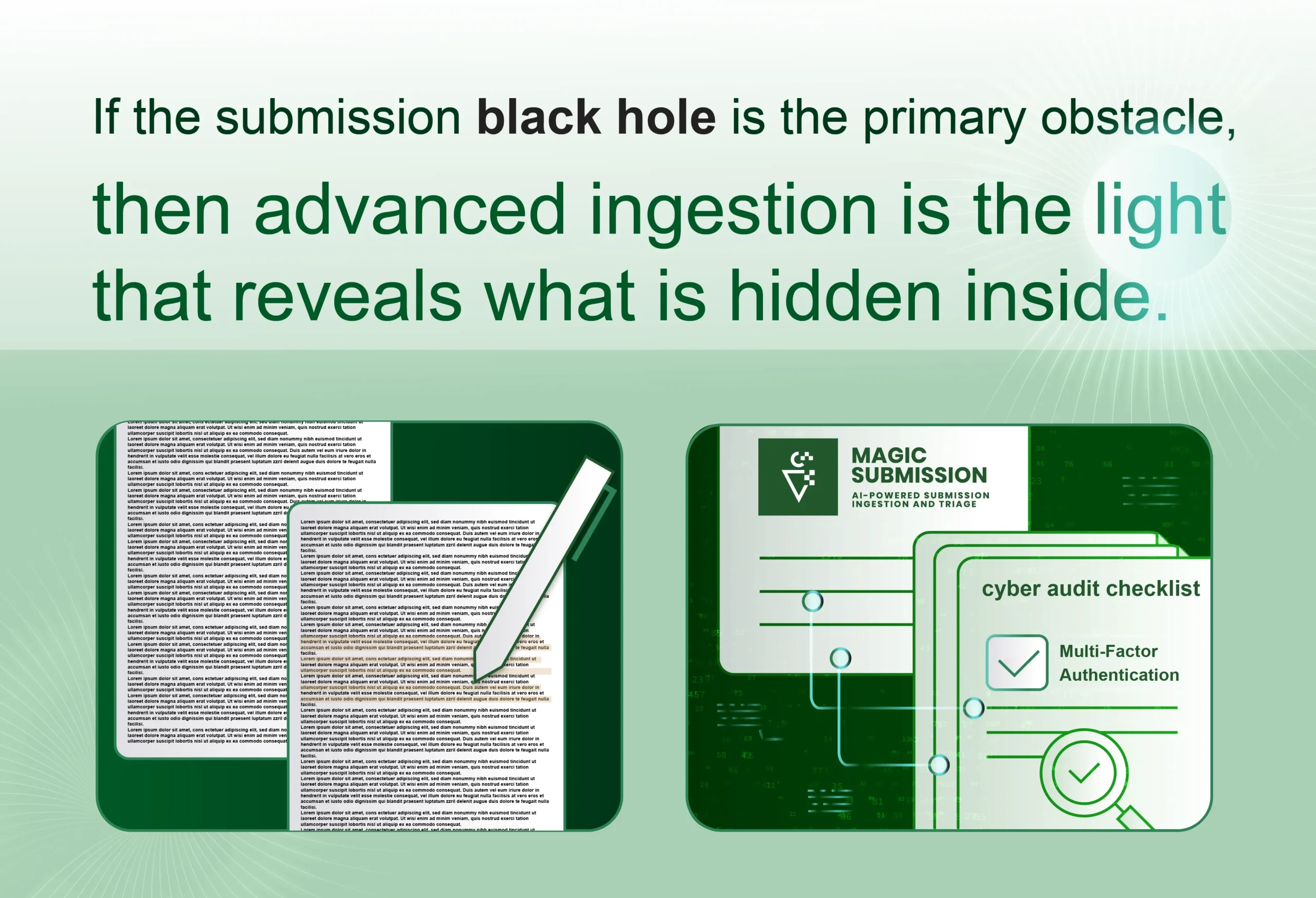
If the submission black hole is the primary obstacle, then advanced ingestion is the light that reveals what is hidden inside. However, to truly solve this crisis, carriers must move beyond the limitations of traditional technology. For years, the industry relied on basic Optical Character Recognition (OCR). While this technology is capable of turning an image of text into a digital string, it lacks the cognitive ability to understand what that text actually means. In the high stakes world of cyber risk, simply reading the words isn’t enough to get a deal done.
Modern distribution requires automated intelligence that understands how different data points connect, eliminating the endless back and forth requests that stall deals. IntellectAI’s submission ingestion tool, Magic Submission, shifts this paradigm by acting as an intelligent triage engine built to strip the administrative friction out of the broker-carrier relationship. Powered by Agentic AI and Large Language Models, the system unbundles complex application packets, identifies hundreds of different document types, and extracts risk attributes with high precision.
For brokers, this means the system understands context the way an underwriter does. For example, when evaluating security protocols, Magic Submission doesn’t just look for the phrase, “Multi-Factor Authentication.” It understands that a casual mention of a login security measure in a client’s email satisfies a core requirement of a formal cyber audit.
By automatically connecting these dots, the platform turns a chaotic pile of client documents into a structured asset. For the distributor, that translates directly to fewer touchpoints, zero wasted time, and a dramatically accelerated path to a bindable quote.
The Power of Purple Fabric
At the core of this transformation is IntellectAI’s proprietary Purple Fabric AI architecture. This framework is purpose-built to extract actual intent and context, meaning brokers don’t have to change how they talk about risk. While traditional, rigid systems delay quotes because a submission doesn’t match a specific form field, Purple Fabric understands the nuances of how you and your clients describe security measures.
It recognizes that a client who uses “daily off-site replication” and one who relies on nightly cloud backups are meeting the exact same underwriting standard. By identifying the underlying meaning, the system automatically maps your unstructured notes and attachments to the specific fields required by a carrier’s rating engine. This removes the burden of manual interpretation and data correction. For the broker, it ensures your submission is instantly ready for a decision the moment it arrives, completely eliminating the friction of rigid portal requirements and giving you a faster path to a bindable quote.
From Recognition to Reasoning
What happens when technology can reason through a submission packet like an expert underwriter? Unlike rigid legacy automation, Agentic AI acts as an autonomous assistant that can navigate complex documents to find missing information on its own. If a supplemental application is incomplete, the AI doesn’t automatically trigger a frustrating email back to the broker. Instead, it cross references the primary application or an attached SOC2 report to find the answer. By validating and enriching this information against thousands of external data sources, the system verifies the submission instantly.
This solves a massive operational headache for brokers. It dramatically reduces the number of follow-up questions, missing information requests, and clarification loops that stall deals.
When a carrier’s system handles the heavy lifting of data verification in seconds, underwriters are suddenly freed up to do what they do best- hop on the phone with you, negotiate terms, and find creative ways to write your complex risks. The chaos of the submission inbox transforms into a streamlined, high-speed digital pipeline.
By automatically bridging these data gaps, carriers can handle a much higher volume of business without sacrificing quality, ensuring that your submissions get the immediate, expert attention they deserve.
Solving for Chaos: The Cyber Risk Challenge
If intelligent ingestion provides the brain, then the cyber risk market provides the ultimate stress test for carrier responsiveness. Cyber risk is notoriously fluid, and packaging it for a quote has traditionally been an exercise in unstructured chaos. To build a complete picture, a broker has to synthesize data from a dozen different directions, reconciling client summaries with disparate security audits, varying loss histories, and diverse risk assessments that rarely follow a uniform template.
The bottleneck isn’t the data itself. It’s that traditional carrier systems expect every submission to look identical. One client might have a detailed ransomware questionnaire, while another provides a high level summary of a SOC2 report. When a carrier lacks the flexibility to handle this diverse mix, the submission gets stuck. The process of risk selection grinds to a halt as underwriters are forced to perform manual forensic accounting on your files.
This lack of adaptability is what kills the speed-to-quote that disruptors rely on. Solving the cyber challenge means building a system that can take whatever formatting your client has available and translate it instantly, turning a chaotic mix of documents into a fast, bindable reality.
The Triage Logic and Data Triangulation
Modern distribution platforms solve this data chaos through sophisticated triage logic. Instead of forcing brokers to act as go-to betweens for missing technical details, the system integrates IntellectAI’s Data Enrichment solution, Risk Analyst. This allows the carrier to automatically cross reference the initial submission with deep third party intelligence to fill in any missing data points instantly.
Imagine a scenario where a client’s submission is missing specific details about their patch management policy. In the past, this would trigger a long chain of back-and-forth emails, stalling the placement process and forcing you to track down the client’s IT team for answers.
Instead,the AI system pulls directly from external telemetry and firmographic data to verify the applicant’s digital hygiene on the fly. It checks for open ports, domain health, and leaked credentials in real time. For the broker, this means the submission keeps moving forward without interruption. You get a faster, fully verified quote to present to your client, completely bypassing the friction of administrative delay.
Verifying the Truth Behind the Data
This capability introduces a vital advantage for the modern distributor. A cyber application is often just one piece of a complex puzzle, and clients don’t always have the perfect visibility into their own networks. By triangulating data in the background,the system identifies potential underwriting discrepancies before they turn into declinations or future claim issues.
For example, if the client states the company uses multi-factor authentication for all remote access, but external scans suggest otherwise, the system flags this discrepancy immediately.
Instead of catching this weeks into the underwriting process, or worse, after a breach occurs, this automated verification gives brokers the real-time insights they need to consult effectively with their clients. By the time the underwriter reviews the file, the data has been cleaned, vetted, and contextualized.
The result is a streamlined process that protects everyone involved. The broker gets a fast, accurate quote built on a verified foundation, ensuring that the final policy is bulletproof and the client’s coverage is truly secure.
Recommended Resource: If your brokerage is struggling with the slow, error-prone process of managing complex carrier quotes, you’ll want to read our deep dive on AI-powered quote extraction. It outlines a 5-step automated pipeline that slashes operational processing costs by 30%. You can download the complete Magic Placement use case
From Chaos to the Gold Standard Profile
The culmination of this technological journey is the creation of the Gold Standard Profile. This is not merely a digital version of a paper application; it is a unified, enriched, and decision grade digital twin of the risk. In an industry where information is often fragmented and stale, the Gold Standard Profile represents a single source of truth that allows carriers to issue quotes with unprecedented speed.
What makes a profile reach this gold standard? It requires a transition from raw data to actionable intelligence. When a carrier operates with these high fidelity profiles, the guesswork, endless questions, and long waiting periods vanish.
Instead of sitting in a queue for weeks, your submissions are fast-tracked because the data is already verified and ready for a final decision.
For brokers, this means a massive competitive advantage. A future of predictable pricing, rapid turnaround times, and higher hit ratios. By transforming the chaos of the submission process into a decision-grade profile, we clear the path so you can protect your clients and grow your business.
The Transformation Process
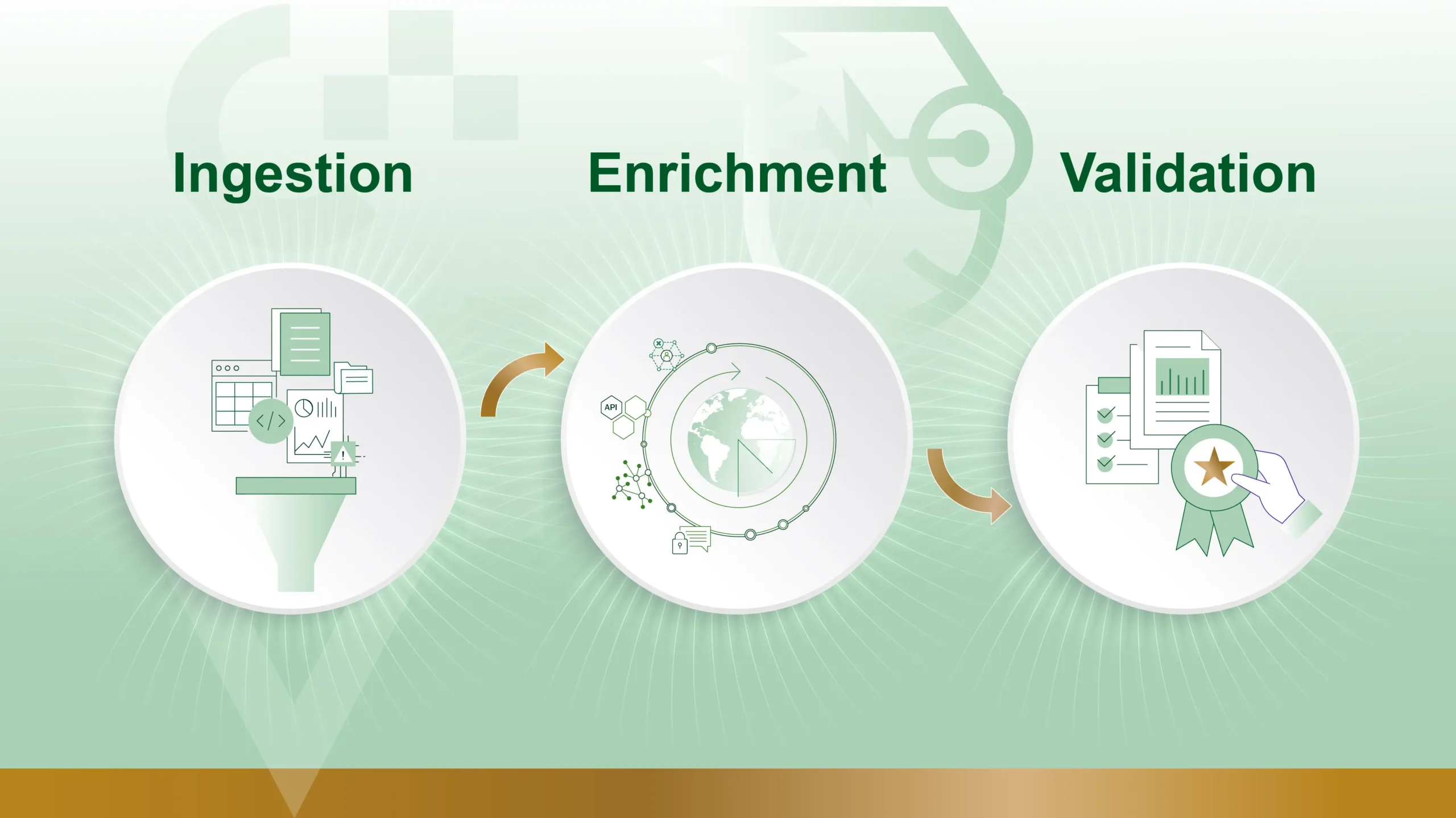
To reach this level of clarity, our distribution ecosystem employs a streamlined three stage pipeline that strips away noise and highlights risk signals.
- Ingestion: Magic Submission extracts relevant data points from the unstructured chaos of emails and attachments, ensuring no critical attribute is left behind.
- Enrichment: Risk Analyst augments the file with third party firmographic data and real time security telemetry to provide a multidimensional view of the applicant.
- Validation: A human in the loop check finalizes the process, combining AI speed with expert oversight to ensure one hundred percent accuracy for regulatory and underwriting standards.
The Value of a Digital Twin
By the end of this process, the carrier is no longer looking at a collection of PDFs. They are looking at a digital twin of the risk that is ready to be rated. This structured asset allows for seamless integration into the carrier’s internal systems, removing the need for any further manual entry.
When the data is this clean and this comprehensive, the speed of the distribution ecosystem accelerates. The underwriter can spend their time on the nuanced art of risk selection rather than the mechanical chore of data validation.
Strategic Impact: Accuracy, Speed, and Appetite Matching
The transition from a manual workflow to an AI-driven ecosystem does more than just clean up data; it fundamentally upgrades the carrier’s ability to partner with the distribution channel. In the current market, accuracy and speed are often at odds. If an underwriter moves too quickly, they might misprice the risk. If they are too meticulous, the broker loses the deal to a faster competitor.
By leveraging the Gold Standard Profile, carriers can evaluate a risk against their appetite the moment it enters the system. For brokers, this means immediate clarity. You no longer have to guess whether a risk fits a carrier’s footprint or wait weeks for a declination. .
This shift from reactive processing to proactive underwriting allows the carrier to operate with a level of agility that modern distributors demand. The result is a highly responsive partnership where you get fast, reliable pricing, accurate terms, and the decisive answers you need to win the account.
Instant Appetite Matching
One of the most immediate benefits of this structured data is its ability to accelerate how you market an account. In a traditional environment, a broker submits a file, and it sits in a queue for days while an underwriter manually deconstructs it, only to eventually announce that the risk falls outside their current guidelines. This is a massive drain on your marketing velocity and a primary reason deals stall during renewal or placement season.
With Magic Submission and the resulting Gold Standard Profile, that waiting game is eliminated. The system instantly evaluates your submission against the carrier’s precise underwriting rules the moment it arrives. .
Risks that perfectly match the target profile are fast-tracked for immediate quoting, while those that don’t are identified right away.
This brings unprecedented efficiency to the marketing process for brokers. Instead of wondering where a file stands, you get instant clarity on which carriers are ready to aggressively compete for your business, allowing you to finalize your marketing strategy and secure the best program for your client without delay.
Closing the Loop with Magic Placement
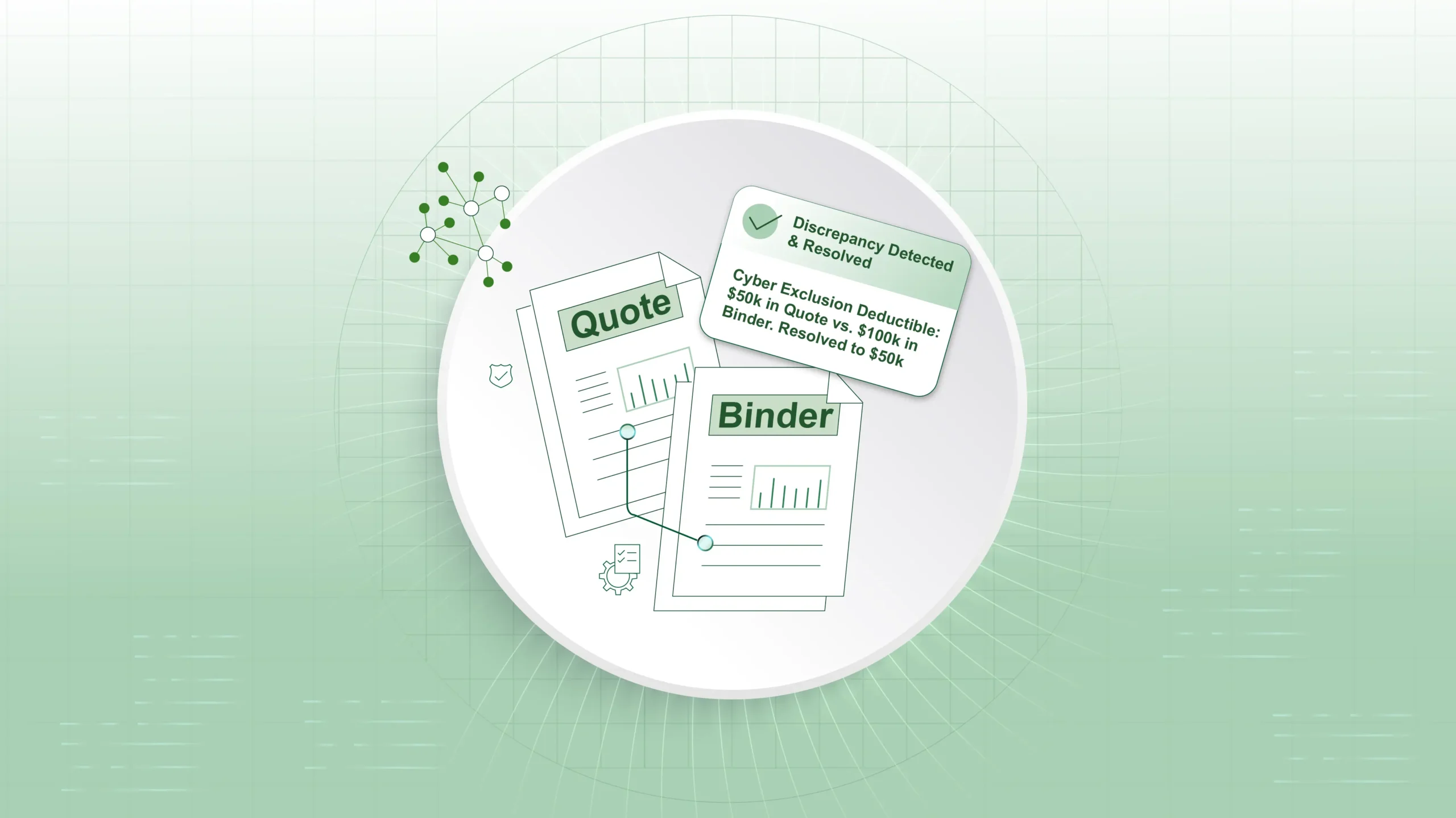
While Magic Submission brings the data in, IntellectAI’s Magic Placement solution ensures that it remains accurate as it moves toward issuance. This solution is specifically designed for brokers to eliminate the manual, error-prone process of comparing insurance documents. By leveraging Agentic AI and Large Language Models, Magic Placement performs a side-by-side analysis of quotes, binders, and final policies to catch discrepancies that the human eye might miss.
Imagine the risk of a binder being issued with different terms than the original quote. Magic Placement identifies these mismatches instantly, highlighting inconsistencies in limits, deductibles, or specific cyber exclusions. This does not just speed up the process; it drastically reduces Errors and Omissions exposure for both the carrier and the broker.
By providing this high-speed verification, Magic Placement allows for faster policy issuance and ensures that the final digital twin matches the original underwriting intent. It raises a vital question: in a world where a single mismatched term can lead to a multi-million dollar liability, can you afford to rely on manual document review?
Conclusion: The Future is Structured
The transition from the submission black hole to the Gold Standard Profile represents more than just a technical upgrade; it is a fundamental shift in how carriers show up for their distribution partners. For too long, the industry has allowed administrative friction and unstructured data to slow down deals and strain relationships. By illuminating this space with Agentic AI, carriers can finally free up their underwriters to do what they do best: collaborate with you to write complex risks.
When your submissions are ingested with context, enriched with real-time intelligence, and fast-tracked through an automated pipeline, the entire distribution ecosystem wins. . Speed no longer comes at the expense of accuracy, and growth no longer requires an unsustainable increase in manual labor.
The future of cyber insurance belongs to the partnerships that can transform information into a bindable quote the moment it arrives. By adopting a process built around the Gold Standard Profile, carriers gain the agility to give you the rapid turnaround times, transparent appetite matching, and seamless experience that the modern market demands.
As you look at your own placement pipeline heading into the next renewal season, ask yourself: Are your carrier partners focused on helping you secure coverage, or are they holding you back with slow, outdated processes? The tools to eliminate the submission black hole are here today, ready to turn your client data into a powerful competitive advantage.
See the Ecosystem in Action
Are you ready to eliminate the submission black hole and get your clients the fast, bindable quotes they deserve? Discover how our suite of AI-driven solutions can accelerate your placement timeline and help you win more business.
Request a Demo to see the ecosystem in action and witness the Magic firsthand.
Download the Magic Submission Brochure for a deep dive into how we are reimagining the intake process for commercial and specialty lines, including Cyber insurance.



Cara Carlone


Ishan Kapse

Related Articles

Elevating Commercial Lines at ITC InsurTech Connect 2026: Built by Insurance Veterans, Driven by Results

Broker Appreciation Month: Transforming Wholesale Distribution

The Last Mile of Wholesale Insurance Digitization: Why the Insurance Placement Process is Broken (and How to Fix It)