




January 12, 2026
Enterprise AI in 2026: Why the Hardest Part Still Isn’t the Technology
By 2026, most companies will no longer wonder if AI works. That debate is over. The bigger question, emerging in boardrooms and leadership meetings, is this: Why is it still so challenging to make AI initiatives succeed, scale and embed them in organisational processes?
The answer is clear. The issue is not with models, tech stacks, platforms, or computing power. It is about organisational strength. Like any untrained muscle, organisations struggle when there is pressure to scale any new technology and show RoI.
The Illusion of Readiness
Over the past few years, enterprises have launched numerous AI pilots. Proofs of concept are familiar with several early success stories. Yet industry evidence continues to show that most AI initiatives struggle to translate into sustained, enterprise-wide impact. What breaks is not always the technology. It’s usually other organisational factors, like decision rights remaining centralised. Teams are optimised for predictability, not learning. Delivery models assume certainty in domains where outcomes are probabilistic and not deterministic, like traditional technologies.
AI changes the operating context in which organisations perform. Practices that evolved for stable, linear, predictive systems are now being applied to adaptive, probabilistic ones. The resulting friction is not a failure of technology, but a signal that enterprise operating models must evolve.
Transformation Starts Where Comfort Ends
Every meaningful enterprise shift begins with discomfort. When cross-functional, multi-skilled teams work together in new ways, with greater autonomy, tighter feedback loops, and real accountability, familiar fault lines surface quickly. Silos become visible. Legacy systems push back, incentives misalign, and governance strains.
We have often heard this phrase ‘discomfort’ described in physical terms. A common comparison that one can relate to is marathon training – not race day, but the first week of training. Everything aches. Progress feels slow. Yet, there is a quiet realisation that certain muscles exist that were never consciously trained for strength and long-term resilience
Enterprise AI transformation feels the same. The discomfort is not a signal to stop, but a pointer for a reality check of the capabilities that need building to achieve your ambition.
When Legacy Hits Back – and It Always Does
There is no straight-line transformation progress map. There is always a phase where enterprises experience the momentum slowing, doubts creep in, and legacy habits reassert themselves as leadership instincts shaped by earlier operating models resurface. Systems designed for control push back against speed, and processes built for stability strain under experimentation.
This stage is like the middle rounds of a Rocky Balboa fight – bruised, tired, aware of the odds, but still standing. It is because stopping is no longer an option, and not because the fight is easy. Here is where many AI programmes quietly diverge, not because of technology choices, but because of leadership responses.
Do leaders add layers of processes? Do they remove friction? Do they protect learning velocity, or lean towards certainty by default? Do they invest in capability while outcomes are still uneven, or wait for proof that may never come?
By 2026, it will not be ambition that separates enterprises, but their ability to hold their nerve when legacy pushes back — and to keep moving forward even when the fight stops feeling heroic.
What This Means for CXOs Entering 2026
AI transformation is no longer a question of starting. It is a question of sustaining. The most effective leaders are making a subtle but critical shift in how they frame the challenge: Enterprise AI is not a project lifecycle. It is an organisational condition. This shift changes everything – from how teams are structured, how decisions are taken, and the way success is measured.
At Netflix, for instance, AI is not rolled out through initiatives; machine learning continuously shapes how content is discovered, tested, and personalised, making learning systems inseparable from everyday decision-making. This is where design thinking becomes critical – not as ideation, but as the discipline that embeds AI into end-to-end journeys, workflows, and feedback loops so learning systems can operate reliably at scale. In this context, design thinking provides the discipline to integrate AI into real decision journeys – ensuring learning systems enhance how organisations sense, decide, and adapt, rather than remaining isolated experiments.
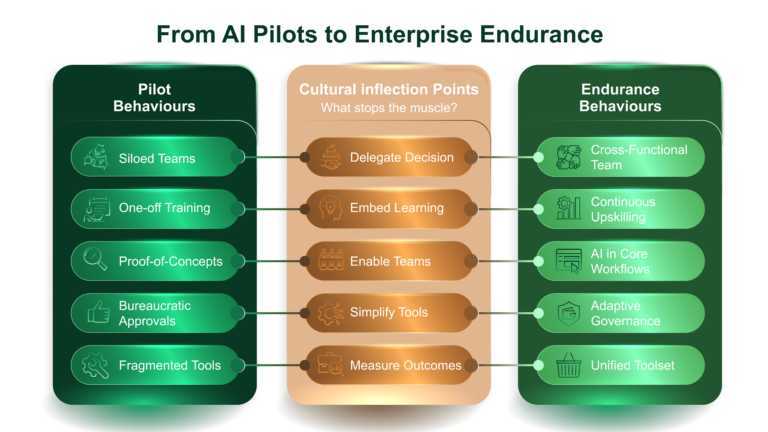
Enterprise AI Endurance Signals for 2026
Not a roadmap. Not a maturity model. Simply the patterns that consistently show up when AI survives contact with enterprise reality.
Momentum Is Not Accidental
When empowerment meets repetition, something changes. Momentum is not speed. It is a belief reinforced by evidence.
Teams stop pushing against the system and start moving with it, compounding the learning compounds. Confidence grows – not because uncertainty has disappeared, but because the organisation has learned how to operate within it.
It is the juncture point where AI stops feeling experimental and starts behaving predictably. Not perfectly, but reliably enough to matter.
Roller Coasters, Not Railroads
One of the most damaging expectations enterprises carry into AI transformation is the desire for smoothness.
Enterprise AI does not behave like a train on a track. It behaves far more like a roller coaster – loops, dips, sudden accelerations, and moments that test balance rather than direction.
This volatility is not a flaw. It is a design condition.
The organisations that will thrive in 2026 are not those seeking frictionless execution, but those designed to absorb volatility without losing direction.
That requires:
- Systems thinking rather than point optimisation
- Service design that balances customer outcomes with provider sustainability
- Operating models that treat pressure as normal, not exceptional
AI rewards organisations that can stay upright while accelerating.
From Projects to Organisational Capability
There is a moment – often underestimated – when delivery begins to feel almost effortless. One would have perhaps heard teams describe it, half-jokingly, as Santa’s workshop. Not because it is magical, but because the conditions finally exist for repeatable outcomes. The right people. The right tools. Clear intent with a rhythm that sustains itself. At that point, AI stops behaving like a programme. It becomes organisational capability, which, once built, compounds quietly.
We see this most clearly in organisations where AI has stopped being discussed as a programme altogether. Firms such as Amazon and JPMorgan Chase rarely describe their work in terms of AI initiatives; instead, learning systems are embedded into how decisions are made, risks are managed, and operations are run. The result is not spectacle, but consistency – delivery that compounds quietly because it has become part of the organisation’s muscle memory.
Where Enterprise AI Will Actually Be Won
As we look ahead, one truth stands out: Enterprises will not win with better AI. They will win with better endurance and a transformed collective mindset.
The organisations that succeed in 2026 will not be those with the most pilots, the largest models, the largest number of agents or the loudest narratives – but those that invested early in the more complex work of building muscle.
AI does not reward excitement. It rewards discipline. Discipline, unlike technology, cannot be bought. A successful Enterprise AI will be one that consciously weaves these into its ethos.
Author:

Rajesh Muthuramalingam
Global Head of Enterprise AI Delivery, Products & UK Go-To-Market

Related Articles
What Makes a Redress Decision Explainable to Regulators?

How to Choose the Right Wealth Management Software for Your Firm in 2026

What Does the FCA Expect From Firms During Large-Scale Redress?