




January 19, 2026
Beyond the Hype: AI in Testing—The Strategic Shift for 2026
The 15% Leakage Problem: Why Traditional QA is an Inherited Constraint
Too many business leaders still view quality assurance (QA) as a necessary, non-revenue-generating activity, resigned to slow, multi-month cycles and persistent defect leakage—often exceeding 15%. The prevailing belief is that adopting Generative AI (GenAI) is either too expensive or too risky for highly regulated domains like Financial Services or Environmental, Social, and Governance (ESG). For many years now, we have been operating under the inherited constraint that slow, manual validation is inevitable for handling massive, unstructured data, at best being able to automate a percentage of this testing.
The Talent Redefinition: From QA Teams to Quality Systems
The real impact of GenAI in QA isn’t about eliminating human capital; it’s about eliminating waste and redefining the value of human expertise. Our experience within IntellectAI confirms: AI’s primary purpose is to transform QA from a reactive gatekeeper into a proactive, high-value function.
While we successfully streamlined the operational QA validation function for a major ESG project from five members to a single LLM QA engineer, it is critical to note that this is not a blanket downsizing recommendation. It is a redistribution of roles across governance, validation design, and exception handling. This shift forced us to strategically invest in human capital, upskilling 30+ testers in prompt engineering and building an innovators’ group. This transformation led directly to an annual effort saving that doubled year-over-year, ultimately surpassing 1,200 person-days.
Business Impact and Key Learnings
1. Strategic Velocity: Converting Months of Validation into Weeks
The most significant business impact is the radical compression of the validation timeline, which directly affects time-to-market and enables critical business decisions.
- Learning: Contextual Accuracy is the New Metric of Speed. For complex ESG data, we reduced the end-to-end processing timeline from 6 months to just 2 weeks.
- Pattern Generalisation: We see similar compression ratios across Insurance, Wealth, and Regulatory reporting where data is unstructured and validation-heavy. This success is a replicable model, not an anomaly
- Takeaway: Speed in data programmes is no longer about processing faster, it’s about reaching decision-grade confidence earlier. Organisations that still equate QA with prolonged validation cycles are structurally delaying action, not managing risk.
2. Quality Guarantee: Cutting Defect Leakage from 15% to Below 2%
Shifting left—predicting and preventing defects—is the only way to scale quality in modern, agile delivery models.
- Learning: Defect Prediction is Now a Reliable Reality. By applying AI models to historical data, we successfully reduced defect leakage in Insurance and Wealth projects from around15% to less than 2%
- Business Impact: The defect prediction agent, operating at 85% accuracy, uncovers patterns, forecasts coverage gaps, and recommends comprehensive coverage, enabling early defect prevention and stronger product quality before release.
- Takeaway: QA should immediately transition from measuring test coverage to measuring risk prediction accuracy
3. AI Governance: The Three-Tier Framework for Trust and Cost Control
A major obstacle to GenAI adoption is ensuring the quality and cost-efficiency of the LLM outputs themselves for critical, regulated data.
- Learning: Contextual Assurance Requires Three-Tier Validation. We solved the trust problem by implementing a three-tier benchmarking technique to evaluate LLM agent outputs for production readiness. This framework incorporates:
- Exact match validation through direct coding logic.
- Regex-based comparison.
- LLM-based comparison for contextual correctness.
- Business Impact: This rigorous process ensured production readiness without quality compromise and resulted in an 85% cost saving on LLM inference by strategically reducing the need for expensive contextual checks.
- Takeaway: If your solution relies on GenAI, you must build a robust “validation of the
validator” framework to ensure accuracy and cost control.
4. The New Operating Model: Deploying a Suite of Autonomous Agents
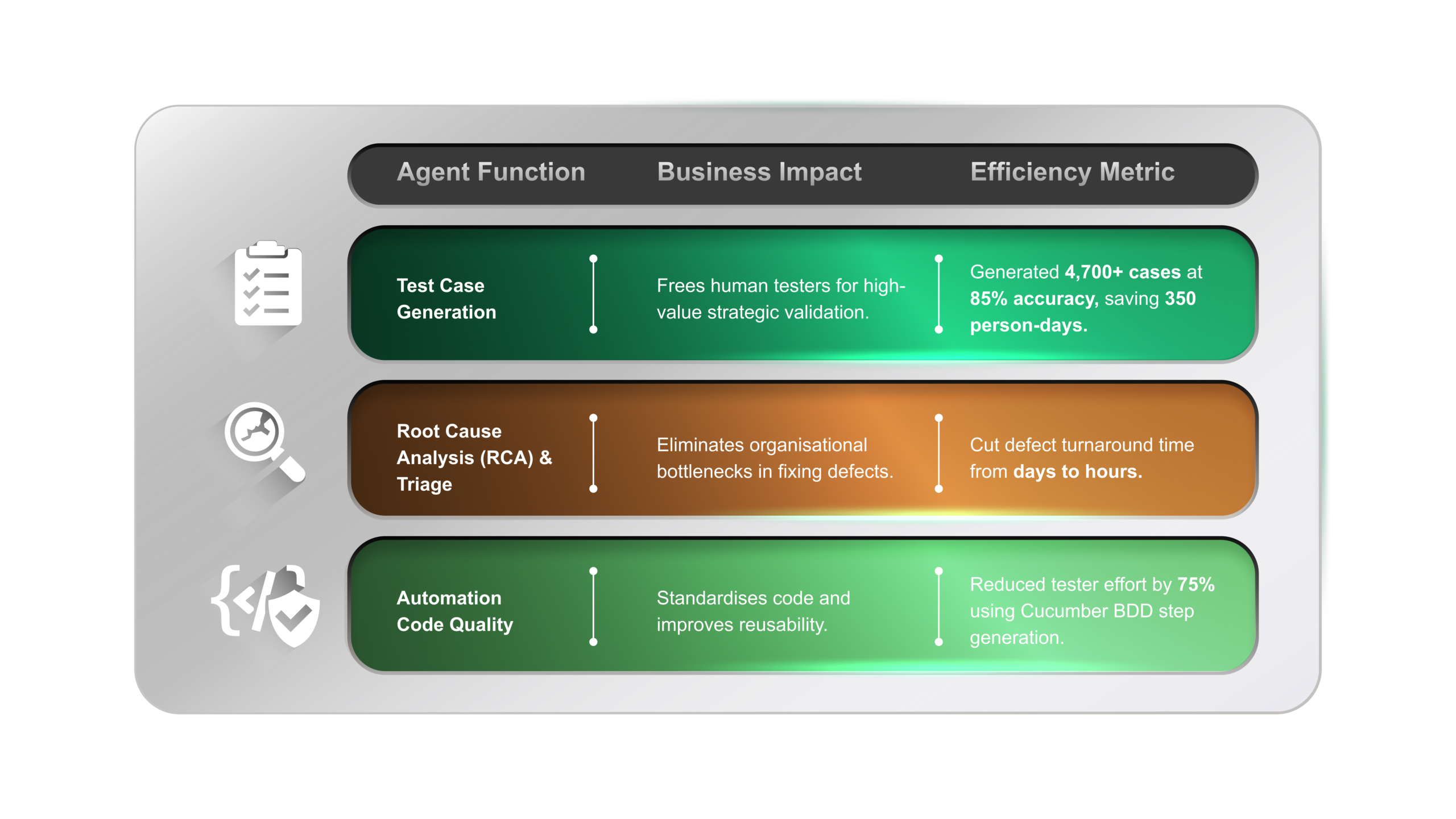
Autonomous Quality is not one agent—it is a coordinated system of specialists. We moved beyond simple automation scripts to deploying a suite of specialized GenAI agents, each addressing a high-impact pain point.
The 2026 Mandate: Your Blueprint for Autonomous Quality Engineering
The hype phase of AI in testing is officially over. We are now firmly in the era of Autonomous Quality Engineering. This aligns with the broader shift Gartner and regulators are signalling toward explainable, AI-assisted assurance models.
Our Strategic Takeaways for 2026:
- Prioritize Agent Specialization Over Monolithic Tools: True efficiency comes from deploying a suite of GenAI agents designed for specific tasks, not from seeking a single, general platform.
- Upskill, Don’t Just Outsource: The focus must shift from basic domain knowledge to mastering prompt engineering and LLM criteria development. Investing in continuous upskilling and a culture of continuous improvement drove significant productivity gains and helped keep attrition levels below 10%.
- Validate the Validator: For any critical, regulated data, implement a robust multi-layer validation strategy (exact match, regex, contextual).
- Embrace the Lean, Empowered Model: When AI can transform efficiency, the lean, agile delivery model (e.g., 2.5 FTE for Insurance and Wealth) becomes the high-performing standard, not an exception.
Closing Statement
The ultimate lesson of 2025 is that quality assurance is no longer a cost center—it is a strategic accelerator. The era of merely automating existing waste is over. The future belongs not to those who seek incremental savings, but to those who deploy intelligent, autonomous systems that augment human expertise and redefine business potential. By moving from a reactive, month-long cycle to a predictive, week-long competitive advantage, we have set the benchmark for 2026. The strategic shift from managing defects to engineering quality has taken another huge step forwards.
Author:

Andrew Young
Senior Vice President / Delivery Director

Related Articles

What Makes a Redress Decision Explainable to Regulators?

How to Choose the Right Wealth Management Software for Your Firm in 2026

What Does the FCA Expect From Firms During Large-Scale Redress?